Radiant City
The KillerRadiant City is a beautiful district set within a town described as dark, dismal, dusty, and dirty. Planned as a nucleus that might extend beyond itself, it first appears to Bérenger as an answer to urban bleakness and a possible source of happiness. But the district is no model neighborhood: a murderer has made it a place of terror, its residents want to escape, and its likely end is depopulation and demolition. The contrast between its brightness and its danger makes Radiant City a failed utopian promise rather than a refuge secured by beauty.
Setting and Intended Design
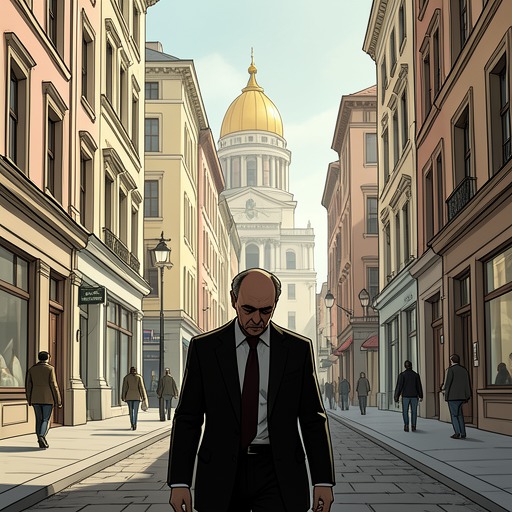
Bérenger encounters the district as a bright enclave within an otherwise mournful city. Its sunny streets and avenues, immaculate walls covered with roses, and radiant appearance seem to distinguish it from the surrounding neighborhoods. He describes it as a city within a city, a place whose light might reach beyond its boundaries. The description gives the district both a concrete form and an expansive promise: its brightness belongs to a particular neighborhood, yet Bérenger imagines it spreading across the world.
The Architect explains that Radiant City was intended to be a nucleus for future expansion. The plan was commissioned by the City Council, and he stresses that he allowed himself no personal initiative. This qualification complicates the district's appearance as a singular masterpiece: the design is beautiful, but its planner presents himself as an official carrying out an order, not as an autonomous visionary. The city's promise is therefore attached to civic planning, while the Architect distances himself from personal authorship of the project.
Access also gives the district an air of uncertain remove. Bérenger recalls hearing incompatible accounts: that it was near or far, easy to reach or difficult to find, and specially reserved; he has even heard that there was no transport. Yet a tram brings him there. The Architect's instruction is that passengers must go as far as the terminus whatever the circumstances, since all trams lead to the depot. Bérenger recognizes the avenues and houses as soon as he arrives, although he says he has never been there before. The gap between rumor and arrival makes the district seem at once obscure and immediately recognizable.
Bérenger's Discovery and Hope
Bérenger's first response is not detached admiration but an almost disbelieving recognition. He says that he had known, without knowing, that such a beautiful district existed somewhere in the town, although he had been afraid to hope for it. Seeing the sunny avenues confirms a possibility that had previously remained vague. His account of the place gathers force through this reversal: what he could scarcely believe becomes, when seen, something he feels he had always known.
His conviction deepens during the visit. Bérenger attributes his renewed sense of self, and his feeling that the world is becoming itself again, to the district's power. He calls its light magical, while The Architect corrects him by identifying it as electric light. The brief correction places a practical source beneath Bérenger's elevated language without extinguishing his response. To him, the radiant appearance is evidence that nothing has truly been lost; the walls, roses, and streets become grounds for renewed confidence.
The district's significance changes sharply when The Architect tells him that its residents want to leave. They have nowhere else to go, so they remain in their beautiful flats and avoid going outside unless necessary. When they do venture out, they move in groups of ten or fifteen, but even numbers do not make them safe. Bérenger initially resists the news, treating it as a joke and accusing The Architect of trying to frighten him. Once the danger becomes credible, the district's brightness no longer reassures him: he says he had felt rooted there, but now sees its brilliance as an empty frame and feels shut out. His sudden change shows how completely his hope had depended on the appearance of the place.
The Threat and the District's Decline
The danger is not simply an atmosphere of unease. Bérenger later explains to Édouard that an insatiable murderer has turned the beautiful district into hell, terrorizing and killing people until the neighborhood is being deserted and may soon cease to exist. Édouard recognizes the case as the beggar who shows people Colonel's photograph and pushes them into the water while they look at it. His familiarity with the method contrasts with Bérenger's astonishment that he knew about the murders. The conversation makes the violence concrete: the district's exposure to danger takes the form of a repeated killing trick, not an unspecified threat.
The Architect describes the residents' choices in bleak terms. They might eventually decide to leave; otherwise, they may all be killed. He says that when the district is completely depopulated, it will be pulled down. The proposed demolition follows from abandonment: once there are no residents left, the built environment itself is destined to disappear. Radiant City's designed permanence is thus reversed. A place planned as a nucleus for expansion instead faces the prospect of erasure, with no guarantee that its beauty can preserve either its inhabitants or its buildings.
Bérenger's change of mind is part of this decline. The Architect observes that he has reconsidered, and says there is no obligation to compel volunteers to live there by choice; no one has to choose a dangerous life. The exchange frames staying not as an unquestioned civic duty but as a voluntary exposure to risk. Bérenger's earlier feeling of having taken root gives way to alarm and retreat as the residents' actual conditions become clearer.
Utopian Promise and Violent Reality
For Bérenger, Radiant City exceeds the scale of a neighborhood. In speaking to The Killer, he imagines that its radiance might have spread over the whole world, becoming a new light from France and bringing happiness even to the murderer. He presents this future as something that required patience: in his account, impatience has spoiled a happiness that could have arrived for everyone. The speech reveals the distance between the district as it exists and the salvific meaning Bérenger has invested in it. His hope is sincere, but the residents' fear and the killings expose how little its polished appearance can guarantee.
The Killer does not answer Bérenger's appeal directly; he chuckles. Bérenger interprets the destruction of Radiant City as the destruction of the Killer's own chance at happiness as well as everyone else's, and wonders whether the murderer regards happiness as impossible and the world as doomed. These are Bérenger's questions and conjectures, not confirmed explanations of the Killer's motives. The contrast leaves the district carrying two incompatible meanings: to Bérenger, it embodies a happiness that might have spread; in the events he describes, it is a place where terror drives people indoors and threatens to empty the streets.
Radiant City's theatrical force rests on that mismatch. Its sunny avenues, rose-covered walls, and electric illumination remain visible signs of beauty, but the residents' isolation and the threat of murder overturn their reassuring promise. The district is neither a perfect community nor a secure refuge; Bérenger explicitly recognizes that its name does not make it a model neighborhood. Its projected expansion gives way to depopulation, and its imagined light spreading outward is set against the possibility that the place itself will be pulled down. The city within a city becomes an image of hope vulnerable to violence, not proof that beauty can overcome it.